Blog
Turning website chat into product feedback
At Vaadin we learned the most from strangers who walked up to our expo stands. I built Stand to find out whether a website can have those conversations too.
November 16, 2026
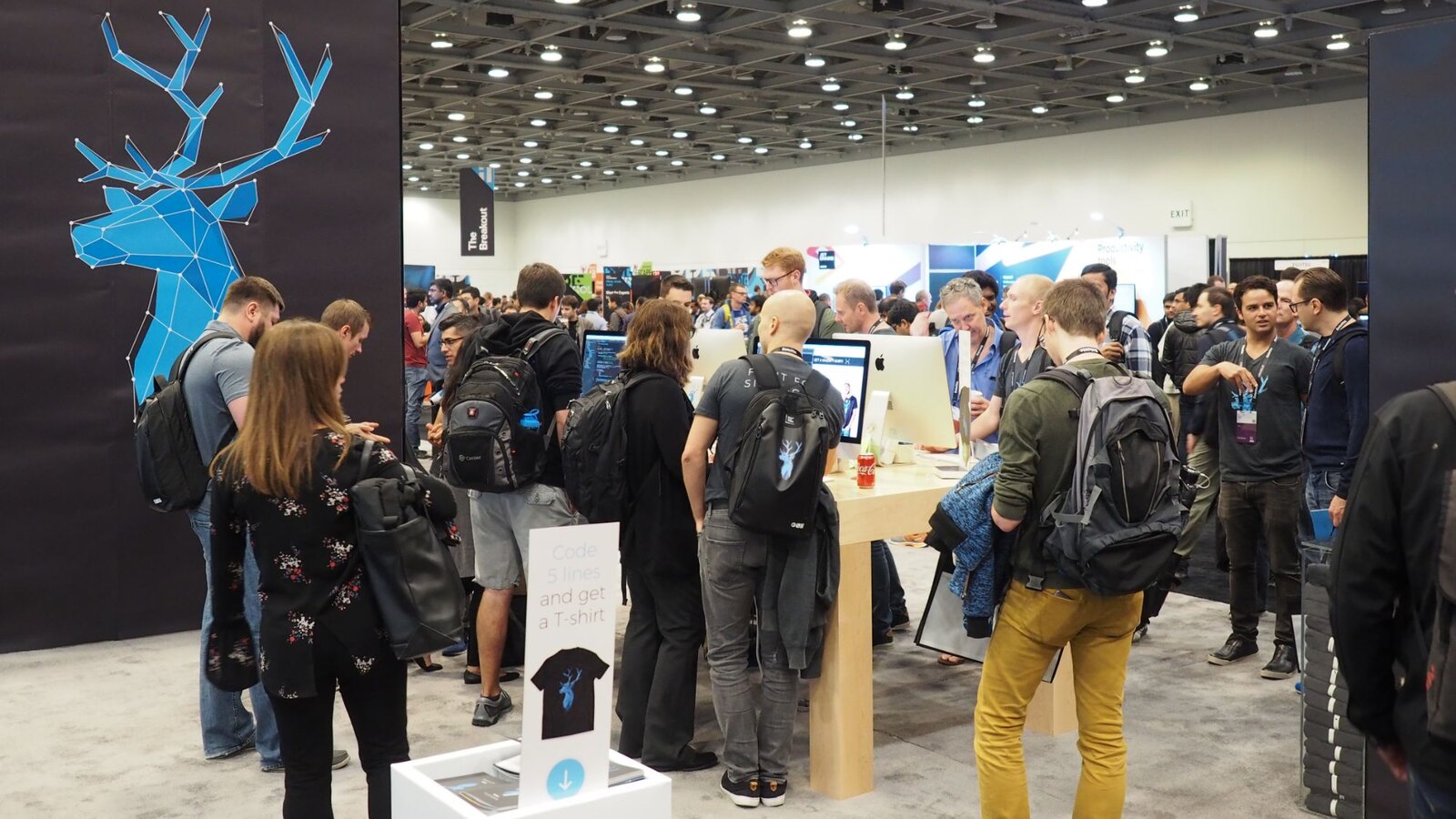
At Vaadin we learned the most from strangers who walked up to our expo stands. I built Stand to find out whether a website can have those conversations too.
November 16, 2026
Between 2009 and 2016 the Vaadin team took part in or organized 531 events. I once went back and listed them all: conferences, meetups, trainings and webinars, starting from JavaOne in San Francisco, where we launched the Vaadin name. In 2014 alone there were about 150, which is three a week.
A stand at a conference was not cheap. Sponsorship, travel and time came to $20,000 for an ordinary event, and the largest went past $100,000. Those stands were still where the team and I learned the most about our own product.
What I wanted to find out is whether a website can have those conversations, every day, for close to nothing. That is why I built Stand.
The most useful talk came from people who did not know anything about Vaadin. They asked questions we had not anticipated. They tried the product at the stand and failed. They made us explain it again when the last explanation had not worked, and they showed us what got them excited. These are the ones I still remember.
In 2015 we were thinking of expanding to Angular. We had a component set we thought was amazing, we packaged it for Angular quickly, and we booked a stand at ng-conf in Salt Lake City.
To our astonishment, nobody in that ecosystem seemed to think reusable UI components had any value. They were not against what we offered, and they thought it looked cool. The notion of not writing every component from scratch just did not compute. Some of them looked closer at what Vaadin Grid did: it loads rows lazily while you scroll and renders fast by recycling DOM elements. Those people saw a glimmer of usefulness.
The support we had built did not vanish overnight, but after that trip we stopped investing in it.
One of our most visual products was a WYSIWYG designer. You dragged components into place and it simply worked. The demo was impressive in theory: a visitor could build a new full-stack Java web app while knowing almost nothing.
In visitors' hands the designer failed in a hundred ways we had never anticipated. We ended up building a new version of the product every day, with the bugs of the day before fixed. Shipping a new build to run at the stand in the middle of an event was not unusual for us. The designer has been through more than ten years of versions since, and countless events.
Vaadin's full-stack web framework is quite complex inside. What it gives Java developers is that they stay in their comfort zone the whole time. We failed in many ways to explain how it works to an audience that did not know the web stack well.
Then some backend Java developers at a stand asked: "So it is like web development for us backend developers?" That clicked for many who came after them. The line that worked came from the other side of the table.
Users surprised us too. The one I remember best is a developer from NASA, who showed us a Vaadin app for iPads that displayed live telemetry from autonomous drones.
vaadin.com had a chat long before AI could answer anything. Our business development team staffed it, and most of the visitors were developers. The team was not very technical, which caused a lot of tension.
The chat still turned out to be one of our top sources of leads. When we managed to help somebody, sometimes by booking a meeting with one of our developers, a connection was built. Trust grew from the connection, and collaboration from the trust. Many significant customer relationships started that way.
So I think it is critical to help the people who come to your site. An AI that knows a technical product inside out can help more of them than our team could.
The idea is many years old: what if you could have this useful stand on the web, and could it lead to some of the conversations that helped us build Vaadin? I was busy with Vaadin and could not have built it.
When I started to think about it properly, AI was quite lousy, so the approach was human first. Then I built it and quickly realized that nobody has time to be at their stand around the clock, or at all when chats are sporadic. That turned the idea around: train a stand-in to stay at the stand for you.
My wife was a visitor on an early pre-release version, and the next problem showed immediately. A person cannot just take over a conversation. It would be rude. (She later adopted Stand for her own business.)
That led to how Stand works now, which is how a hired stand-in works at a real expo. The Stand-in recognizes when a conversation goes in a direction I want to be part of and notifies me. If I am interested and Available, it asks the visitor whether it should invite me in.
Context matters immensely. That has been my main learning so far. A stand at an expo is one size fits all, and it mostly works because of the social norm of politeness. Online, people do not have that norm when they talk with an AI. Leaving in the middle of a conversation is the norm, not the exception.
Here is one chat from August. A visitor on our features page asked four things in under a minute: the price, why they should buy, how the setup goes, and whether leads can be routed to a CRM. The Stand-in answered each, and then asked whether it should bring me in.
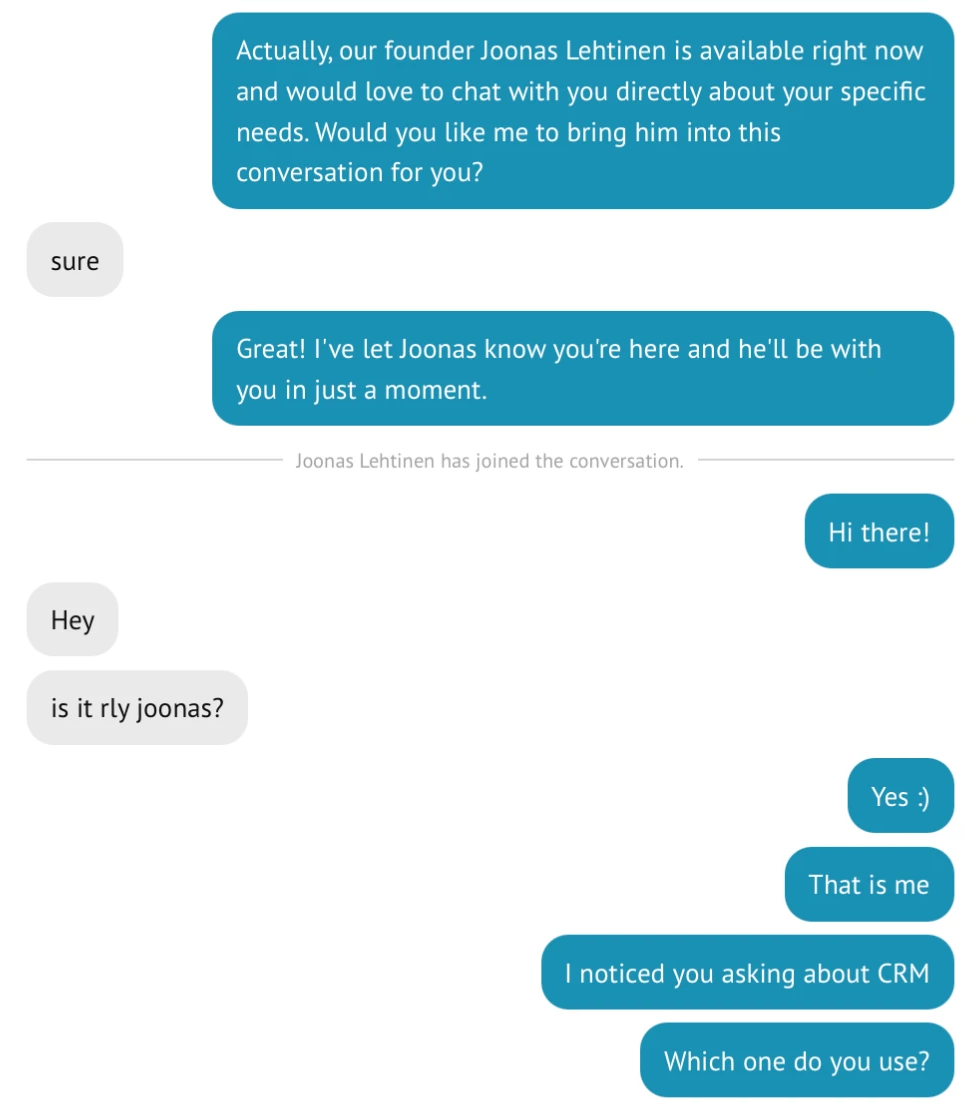
So a chat has to start with context. It also has to be proactive: offer to chat, or even start the chat, in the situation where a visitor needs help. A lot of what we have built into Stand is tools for shaping that to fit your own site.
I miss the moment when you see somebody's eyes light up and hear their voice change, because they have understood the product and realized what they have found.
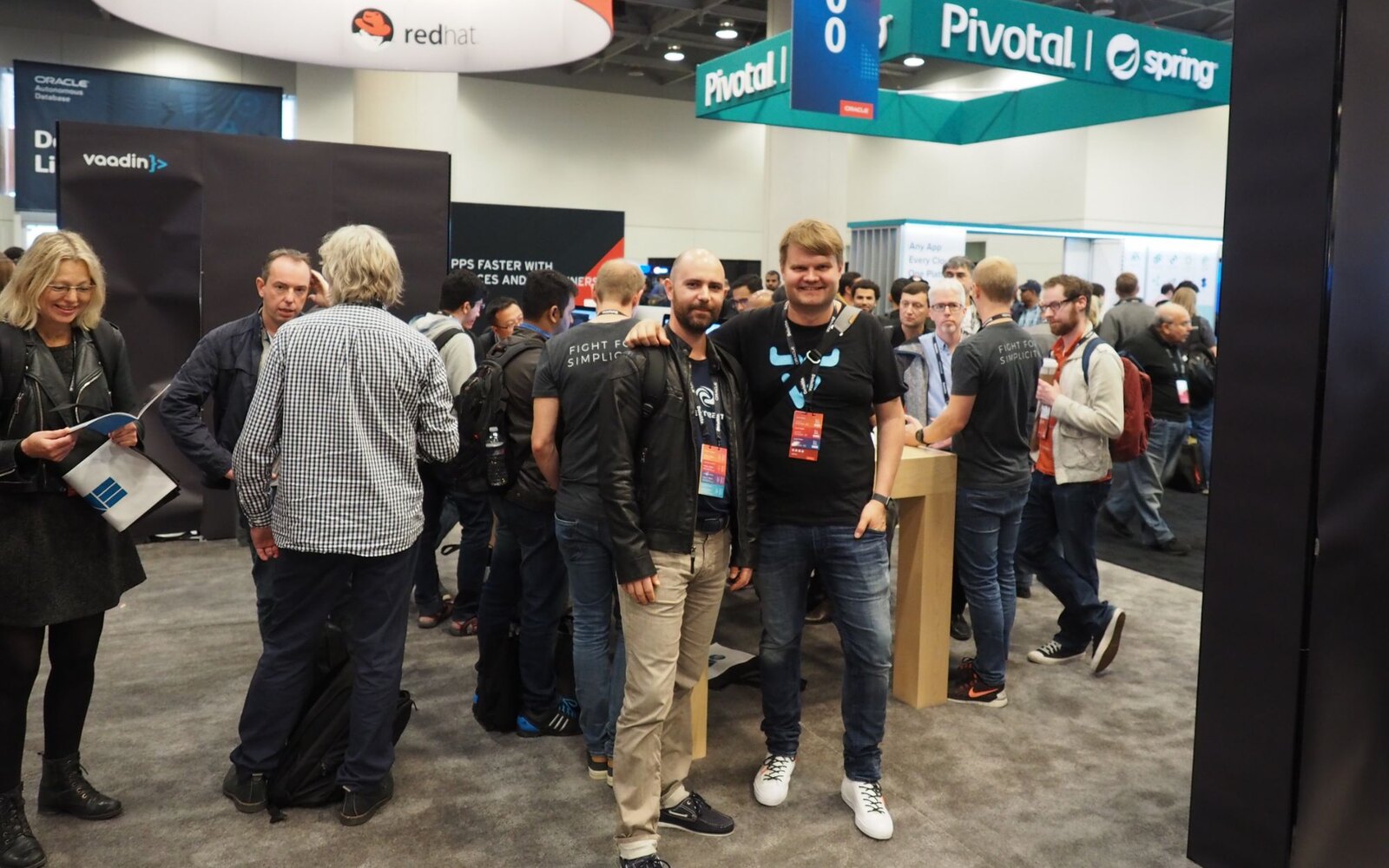
This is one of our stands on a busy day. I am the one in white shoes.
That rarely works the same way online. When a visitor gets excited, they might just leave the chat and go tell a colleague. We do not know.
I cannot yet say that a website gives a product team what those 531 events gave Vaadin. About 500 chats have been closed on stand.chat since launch. It is still very early and thus most of what I could say about results would be speculation.
What I do know is the price. A stand on your own site is practically free, and it is open on the days between the expos.
It also needs somebody to read the conversations. I have a ChatGPT dot do that: every day it reads the chats that have closed and tells me when something interesting comes up. I develop Stand with Codex and Claude, so the dot can reach the codebase as well as the conversations. When a visitor says that something is broken, a summary would repeat the complaint. The dot can go on to check the code and the deployment history and tell me the root cause.
If you have stood at a stand yourself and learned something different, tell me. The chat in the corner of this page is mine.
You need a website where you can add a script tag, and a Stand account. The Base plan costs $0 and asks for no credit card.
openChat and a greeting that fits the place. See Tune chat behavior.